
My pet has a lump. Should I be worried?
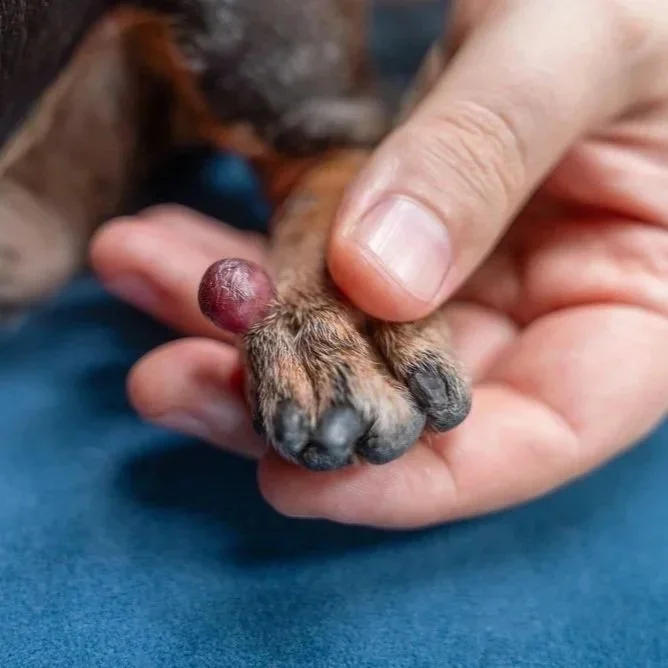
Perhaps you've noticed a lump while patting your cat, or maybe the groomer spotted a skin growth during your dog’s last visit.
Finding something unexpected can be worrying, particularly if we’re worried it might be skin cancer.
Lumps are a relatively common finding in veterinary practice, particularly as our pets get older. Many are benign and may never cause significant problems. Others can be serious and require treatment, best dealt with before they have an opportunity to grow or spread.
One of the challenges for pet families - and indeed for vets - is that lumps with very different biological behaviour can look and feel remarkably similar.
Fortunately, there are several relatively straightforward ways we can investigate them, often during a routine veterinary consultation.
Understanding what a lump actually is helps us make much better decisions about appropriate treatment.
What causes lumps on dogs and cats?
There are many different types of lumps that can develop on or beneath the skin of dogs and cats. Some are more commonly encountered in one species than the other.
Lipomas
Lipomas are benign tumours composed of fatty tissue. They are particularly common in middle-aged and older dogs, although they are less frequently encountered in cats. They often feel soft and mobile beneath the skin.
Many lipomas can be left alone once their identity has been established. However, some become large enough to interfere with movement or cause discomfort because of their location, and in these cases removal may be indicated.
Skin cysts and sebaceous growths
Cysts and benign growths associated with structures within the skin are also common, particularly in dogs. Some appear as small, raised or wart-like lesions. Others contain material that can be released if the cyst ruptures.
These growths are often harmless; however, they can become irritated, inflamed or infected, prompting treatment.
Mast cell tumours
Mast cell tumours develop from cells involved in immune and inflammatory responses and occur in both dogs and cats. In dogs, they can have remarkably varied appearances. Some are firm and raised, while others are soft and resemble fatty lumps. They may also become temporarily larger, redder or more inflamed.
The behaviour of mast cell tumours varies considerably, both between and within species. Many cutaneous mast cell tumours in cats behave relatively benignly, while those in dogs can range from relatively straightforward to treat surgically to considerably more aggressive forms.
Soft tissue sarcomas
Soft tissue sarcomas are a group of tumours arising from connective tissues. They may grow slowly and appear relatively well defined, despite having microscopic extensions into the surrounding tissue. In cats, a particular type of sarcoma can occasionally develop at the site of a previous injection. Identifying these tumours before surgery is particularly valuable because the first surgical procedure can have a significant influence on the long-term outcome.
Mammary tumours
Lumps associated with the mammary glands can develop in both dogs and cats, particularly in females. Mammary tumours in dogs can be benign or malignant. In cats, however, the majority are malignant, making early attention particularly important.
Squamous cell carcinoma
This type of cancer is particularly worth mentioning in cats with white or lightly pigmented skin. It can develop on areas exposed to sunlight, particularly the tips of the ears, nose and eyelids. These lesions do not always appear as distinct lumps. They may initially resemble a persistent scab, crust or small wound that fails to heal. Dogs can also develop these cancers, however the body areas affected are usually different.
Inflammatory lumps and abscesses
Of course, not every lump is a tumour. Infection, insect bites, foreign material and other inflammatory processes can also produce localised swellings. Abscesses are common in cats following bite wounds from other cats. The original wound may be almost impossible to see, while a painful swelling develops beneath the skin over the following days. These swellings may develop relatively quickly and are sometimes accompanied by fever, lethargy or a reduced appetite.
Can you tell if a lump is cancerous from its appearance?
Unfortunately, there are no consistently reliable visual characteristics that distinguish a harmless lump from a malignant tumour.
A soft, mobile lump may well be a lipoma, but some malignant tumours can feel very similar. Likewise, an irregular or rapidly growing lump isn't necessarily cancerous. Inflammation and infection can also produce dramatic changes.
Even for an experienced veterinarian, examining a lump is often only the first step in identifying it.
What is a fine needle aspirate?
One of the most useful initial investigations for a skin lump is a biopsy technique called a fine needle aspirate, or FNA.
This involves inserting a small needle into the lump to collect a sample of cells. The cells are transferred onto a microscope slide and examined - a process called cytology.
For many lumps, particularly lipomas and certain types of tumours, cytology can provide a diagnosis or valuable information about the cells involved.
The procedure is generally quick and can often be performed during a routine consultation without sedation or anaesthesia.
Some samples can be assessed in the clinic, while others are submitted to a veterinary clinical pathologist for interpretation.
Will a fine needle aspirate always provide a diagnosis?
No. Some lumps release cells readily, while others are more difficult to sample. Sometimes a sample contains too few representative cells to establish a diagnosis confidently.
Certain tumours also require examination of their tissue structure rather than individual cells.
In these cases, we may recommend repeating the aspirate, taking a tissue biopsy or removing the lump and submitting it for histopathology. Each of these investigations provides a different type of information.
Why do we recommend testing a lump before removing it?
Understanding the nature of a lump can influence how we approach surgery.
For a benign growth, removing the lump itself may be sufficient. For certain malignant tumours, we may need to remove a wider area of surrounding tissue to reduce the likelihood of tumour cells being left behind.
Depending on the diagnosis, additional investigations may also be appropriate before surgery. This information can help us plan the procedure carefully and provide families with a clearer understanding of what to expect.
Should every lump be removed?
Not necessarily. Some benign lumps can be monitored without causing any problems for the patient.
When deciding whether removal is appropriate, we consider:
The identity and expected behaviour of the lump.
Whether it is growing or changing.
Its location and whether it interferes with movement or comfort.
Your pet's general health.
The benefits and risks of anaesthesia and surgery.
Having a diagnosis can make that decision considerably easier.
What changes should I look out for?
If your pet has an existing lump, particularly one we have previously investigated, it can be useful to monitor its appearance and size. Taking an occasional photograph alongside a ruler can help you recognise gradual changes.
Arrange an examination if you notice:
Any newly discovered lump.
An increase in size.
A change in shape, colour or consistency.
Bleeding or ulceration.
Persistent licking or irritation.
Pain or discomfort associated with the lump.
Remember that a lump that hasn't changed in size is not necessarily benign. Dogs and cats can also develop several different types of lumps at the same time. A new lump should not automatically be assumed to be the same as another that has previously been diagnosed.
When should I have my pet's lump checked?
We recommend arranging a veterinary examination whenever you discover a new lump rather than waiting to see whether it becomes larger.
In many cases, a simple sample can provide considerable reassurance. And if the lump does require treatment, identifying it early may give us more options.
Have you found a lump on your dog or cat?
Our veterinary teams can examine your pet, discuss appropriate sampling or diagnostic investigations and help you decide whether monitoring or treatment is the best approach.