
Why does my dog keep licking their paws?
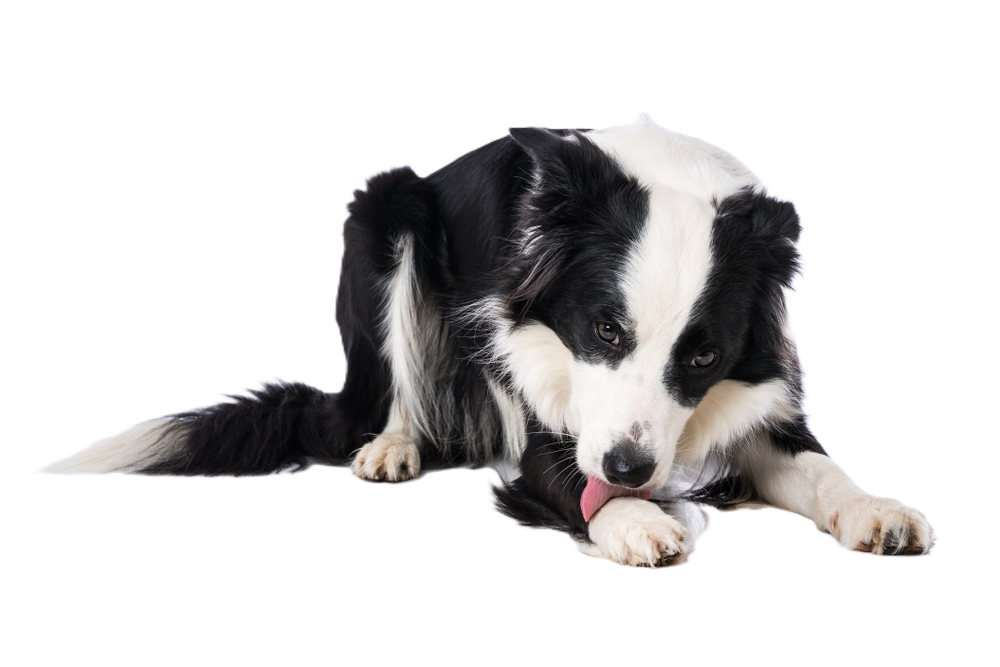
Dogs lick their feet for all sorts of reasons. Sometimes they're simply cleaning their paws after a walk. But when the licking becomes frequent, difficult to interrupt or turns into chewing and nibbling, there is usually a reason.
The pattern can provide useful clues.
One paw or all of them?
If your dog has suddenly started licking one paw, start by looking for something localised to that paw.
A split nail, small wound, embedded grass seed, insect sting or something stuck between the toes can make a dog intensely interested in one foot.
Check the pads, nails and between the toes if your dog is comfortable being handled. Look for swelling, redness, a sensitive nail, discharge or a visible foreign body.
Grass seeds deserve particular attention during the warmer months. They commonly work their way into the skin between the toes and may leave little more than a small swollen area or draining tract.
Persistent licking of multiple paws, particularly when it recurs or changes with the seasons, makes allergic skin disease and infection much more likely.
Why do allergies make dogs lick their paws?
The skin between a dog's toes is a common site for allergic itch.
Dogs with environmental allergies can react to allergens such as pollens, grasses, dust mites and moulds. Paw licking may become particularly noticeable after walks or at particular times of year.
Other clues can include:
recurrent itchy or inflamed ears
redness between the toes
rubbing the muzzle and eyes
licking the abdomen or groin
scratching or chewing elsewhere on the body
recurrent skin infections.
Some dogs have relatively mild seasonal symptoms. Others develop itch that becomes persistent or progressively more troublesome, requiring a strategy to help manage the discomfort.
Food allergy can also produce a similar pattern of itchiness, but it’s not possible to easily distinguish food from environmental allergy simply by looking at the nature or distribution of clinical signs.
Licking can make the problem worse
Repeated licking keeps the skin wet, inflamed and traumatised.
The skin normally carries populations of bacteria and yeast. When its protective barrier is damaged by allergy, inflammation and licking, these organisms can multiply and contribute to further irritation.
This creates a fairly miserable cycle: the paw is itchy, the dog licks it, the skin becomes more inflamed, and the increased inflammation drives more licking.
A secondary infection may cause increased redness, swelling, an unpleasant smell, discharge or staining of the fur.
Treating the itch without recognising and treating a secondary infection can undermine success, and leave a dog considerably more uncomfortable than necessary.
Why are my dog's paws turning brown?
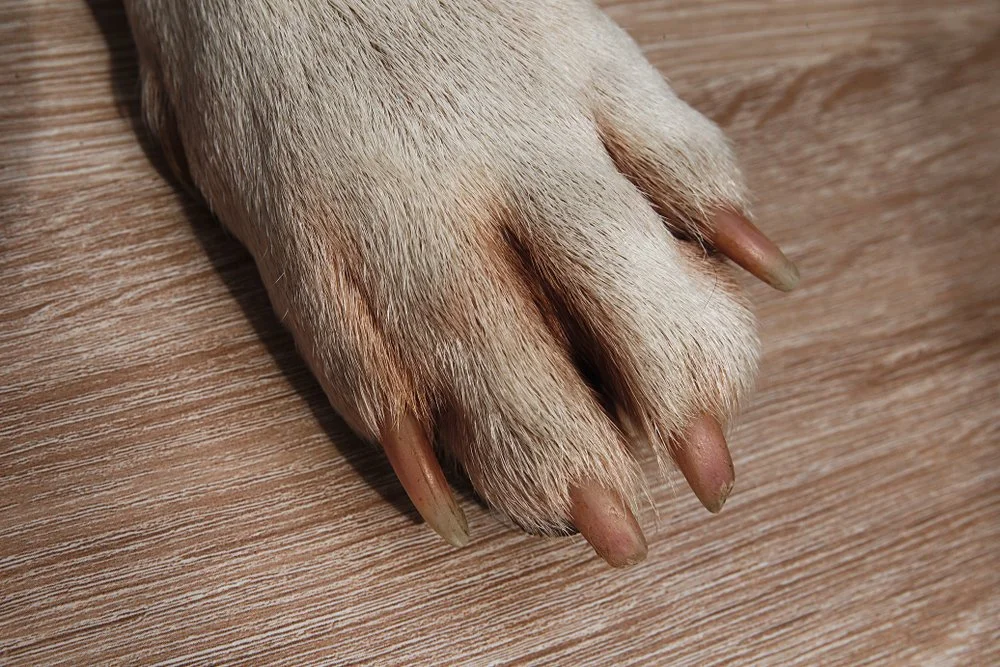
Dogs with pale fur often develop rusty-brown staining where they repeatedly lick.
Saliva contains pigments called porphyrins that oxidise and discolour the hair over time.
The staining itself is not the disease. It tells us that the dog has been licking the area frequently enough for saliva to accumulate there.
Finding out why they're licking is more important than trying to remove the staining.
What can I check at home?
Have a gentle look at the paws if your dog is comfortable with it.
Check:
between the toes
underneath the pads
around each nail
whether one paw looks different from the others
whether there is swelling, redness, moisture, discharge or an unusual smell.
Think about the pattern as well.
Did it start suddenly after a walk? Is one paw involved? Is there a seasonal pattern? Are the ears itchy too? Has your dog had similar episodes before?
Those details can be really helpful when we examine them.
Avoid repeatedly squeezing painful toes or digging around for a suspected grass seed. A sore dog can react unexpectedly, and foreign material can sometimes be pushed further into the tissues.
When should I book a vet appointment?
A paw should be examined promptly if your dog is significantly painful, lame, has marked swelling, bleeding, discharge, a damaged nail or a suspected embedded foreign body.
For an itchy dog, book an examination when:
licking or chewing is persistent
several paws are involved
the skin is becoming red or sore
the problem keeps returning
there are recurrent ear problems
your dog is scratching elsewhere as well
the licking is disturbing sleep or normal activity.
Dogs can tolerate a surprising amount of itch without making much fuss. If they're spending a meaningful part of the day chewing their feet, they're uncomfortable.
What will the vet look for?
Our first job is working out whether we're dealing with itch, pain or both.
We'll examine the paws closely, including the nails, pads and skin between the toes. We'll also usually look at the ears and the rest of the skin, because the distribution of changes can help us recognise allergic disease.
If infection is suspected, skin cytology is a particularly useful test. A small sample from the affected skin can be examined under the microscope for bacteria, yeast and inflammatory cells.
If there is a focal swelling or a suspected foreign body, the investigation can be quite different.
There isn't one test that simply says this dog has environmental allergies. Diagnosis is based on the history, clinical pattern and excluding or treating other causes of itch. Allergy testing can be useful later when allergen-specific immunotherapy is being considered, but it is not a screening test that establishes the diagnosis on its own.
If allergies are causing the itch, what can we do?
For many years, our options for dogs with allergic itch were relatively limited.
We could use physical barriers such as Elizabethan collars or boots, treat secondary bacterial and yeast infections, and provide temporary relief with medicated shampoos, conditioners and topical treatments.
Medical management often relied heavily on corticosteroids. These drugs can be very effective at reducing inflammation and itch, but the prolonged or repeated use sometimes needed for chronic allergic disease can also produce undesirable side effects.
Thankfully, veterinary dermatology now has newer and more targeted treatments that can control allergic itch more precisely and, for many dogs, are better suited to longer-term management.
The right choice depends on the individual dog, how severe and seasonal their symptoms are, their other health issues and whether secondary infection is present.
Two options we commonly use at Evervet are Cytopoint and Zenrelia.
Cytopoint
Cytopoint contains lokivetmab, a canine monoclonal antibody that targets interleukin-31, an important signalling molecule involved in allergic itch.
It is given by injection and is registered in Australia for pruritus associated with allergic dermatitis and the clinical manifestations of atopic dermatitis in dogs.²
For some families, an injectable treatment is particularly convenient because there is no tablet to remember each day, and cytopoint has a long duration of activity providing relief for five to six weeks for many patients.

Zenrelia
Zenrelia contains ilunocitinib, a Janus kinase - or JAK - inhibitor.
It is a once-daily oral treatment registered in Australia for reducing itch associated with allergic dermatitis and the clinical signs of atopic dermatitis in dogs. It was registered by the APVMA in October 2025.
A multicentre randomised controlled trial involving 268 client-owned dogs found that once-daily ilunocitinib produced significant improvements in both owner-assessed itch and veterinary-assessed skin lesions compared with placebo.³
As with other systemic treatments for allergic disease, suitability needs to be assessed for the individual patient. Zenrelia's Australian registration information also recommends ongoing clinical evaluation and blood monitoring during treatment.⁴
Treating the itch is only part of the job
Neither medication removes the need to work out what is happening to the skin.
If there is a bacterial or yeast infection, that may need treatment as well. Dogs with recurrent allergic disease may also still benefit from skin care, parasite prevention, allergen avoidance where practical, dietary investigation in selected cases, or allergen-specific immunotherapy.
The aim is comfortable skin with the least complicated management plan that works for that particular dog.
Why does it keep coming back?
Canine atopic dermatitis is usually a chronic condition. The underlying problem is an abnormal immune response to environmental triggers, which means we can often control the disease very effectively, but it is uncommon to eliminate it completely.
That doesn't necessarily mean a dog will be itchy every day for the rest of their life, nor that every flare will be equally severe. Some dogs have very predictable seasonal flares, while others need longer-term management.
Recognising your dog's early signs can make a considerable difference.
For one dog it may be the ears becoming slightly pink. For another it is licking the front paws after every walk.
Once families identify a pattern, we can often intervene earlier and more effectively, providing relief before the skin becomes badly inflamed or infected.
When your dog's feet are trying to tell you something
An occasional lick after a muddy walk isn't concerning.
Repeated paw licking is different.
One suddenly painful paw deserves a careful check for injury or a foreign body. Several persistently itchy paws - particularly alongside itchy ears or recurrent skin problems - make allergic skin disease much more likely.
If your dog's paw licking keeps returning, bring them in before the skin becomes very sore. Working out what's driving the itch gives us a much better chance of keeping them comfortable, and there’s lots we can do to help make them comfortable.
Is your dog constantly licking or chewing their paws?
Our teams at Prahran, South Yarra, East Melbourne and Hawthorn can help work out what's driving the itch.
References
Mueller RS, Banovic F, Bensignor E, et al. Treatment of Canine Atopic Dermatitis: Updated Guidelines From the International Committee on Allergic Diseases of Animals (ICADA). Veterinary Dermatology. 2026. These updated guidelines cover flare management, secondary infection, skin-barrier care, allergen avoidance, immunotherapy, lokivetmab and JAK inhibitors. Wiley Online Library
Australian Pesticides and Veterinary Medicines Authority. Cytopoint Solution for Injection for Dogs — lokivetmab. Australian approved product label.
Forster SL, et al. Efficacy and field safety of ilunocitinib for the control of atopic dermatitis in client-owned dogs: a multicentre, double-masked, randomised, placebo-controlled clinical trial. Veterinary Dermatology. 2025. The study enrolled 268 dogs and found significant improvement in both owner-assessed itch and veterinary-assessed skin lesions with ilunocitinib compared with placebo. PubMed Central (PMC)
Australian Pesticides and Veterinary Medicines Authority. Zenrelia tablets for dogs — ilunocitinib. APVMA registration information, 2025.