
Is my pet too old for an anaesthetic?
“She's 14. Isn't she too old for an anaesthetic?”
It's an understandable question we hear regularly.
When your dog or cat was younger, an anaesthetic for an elective procedure such as desexing probably didn't feel particularly remarkable. When they're 12, 14 even 16 the same conversation can feel very different.
So, is there an age when a pet simply becomes too old for an anaesthetic?
No. There isn't a birthday after which anaesthesia automatically becomes too risky.
But that doesn't mean age is irrelevant either.
Older pets are more likely to have changes in their heart, kidneys, liver, respiratory system or other conditions that can affect anaesthetic risk. They may respond differently to some medications, become cold more easily and recover differently from younger animals.
That's why the question we ask isn't simply:
“How old is your pet?”
It's:
“What is the anaesthetic risk for this particular pet - and what are the potential benefits of having one?”
A 14-year-old isn't just a 14-year-old
Imagine two patients.
One is a 15-year-old terrier who still walks every morning, has a reassuring physical examination and no significant abnormalities identified during their pre-anaesthetic assessment.
The other is a 10-year-old dog with significant kidney and heart disease.
Which is the better anaesthetic candidate?
You can't answer that from their ages alone.
That's not just our philosophy. Current senior-care guidelines specifically state that advanced age alone isn't a contraindication to general anaesthesia and emphasise assessing the health and function of the individual patient.
Cats are no different.
A healthy older cat may be a very different anaesthetic patient from a younger cat with significant underlying disease.
Age matters, but assessing the whole patient matters more.
We anaesthetise older pets every day
Anaesthetising older pets isn't unusual at Evervet.
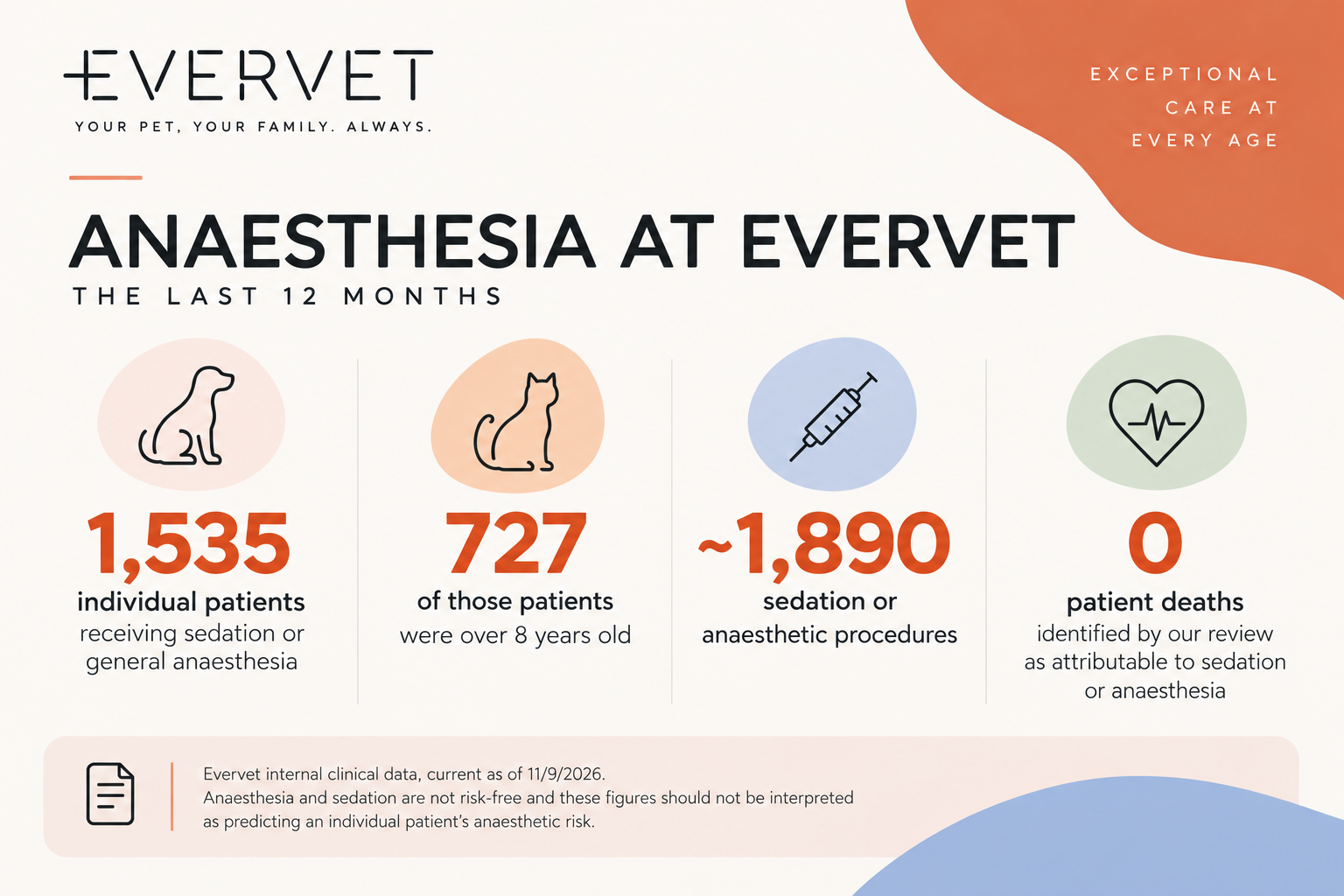
Over the past 12 months, 1,535 individual patients underwent sedation or general anaesthesia at Evervet. Almost half of those patients - 727 - were over eight years of age.
Across approximately 1,890 sedation and anaesthetic procedures during that period, our review identified no patient deaths attributable to sedation or anaesthesia itself.
These numbers don't necessarily mean anaesthesia is risk-free. No anaesthetic is. And our own data can't tell us exactly what the risk will be for an individual patient.
But they do illustrate something important:
Older patients aren't unusual anaesthetic patients at Evervet. They're a substantial proportion of the patients we care for every day, and our protocols, facilities and skilled clinical teams allow us to do so as safely as possible.
How do we assess the risk?
We consider your pet's medical history, medications, previous anaesthetics and any changes you've noticed at home.
Then we perform a complete physical examination.
Depending on your pet, their age, the procedure we're planning and anything we identify, we may recommend additional testing before proceeding.
Blood and urine testing can provide useful information about things such as kidney function, liver function, blood cells and other metabolic abnormalities.
In some patients, there may be a reason to investigate further - perhaps with blood pressure measurement, cardiac assessment or diagnostic imaging.
There isn't one universal “senior pet anaesthetic panel” that makes an anaesthetic safe.
Our experience and testing helps us identify and plan accordingly.
Current anaesthesia guidelines similarly emphasise individual pre-anaesthetic evaluation because identifying underlying physiological or disease-related changes allows the anaesthetic plan to be modified for that particular patient.
What changes if my pet is older?
Anaesthesia isn't simply a standard dose of medication given to every patient.
Drug choices and doses are adjusted. Fluid therapy and other supportive medications can be tailored. Particular attention is paid to maintaining blood pressure and body temperature. Pain relief is always addressed and titrated to the individual patient and procedure.
And throughout the anaesthetic, monitoring matters.
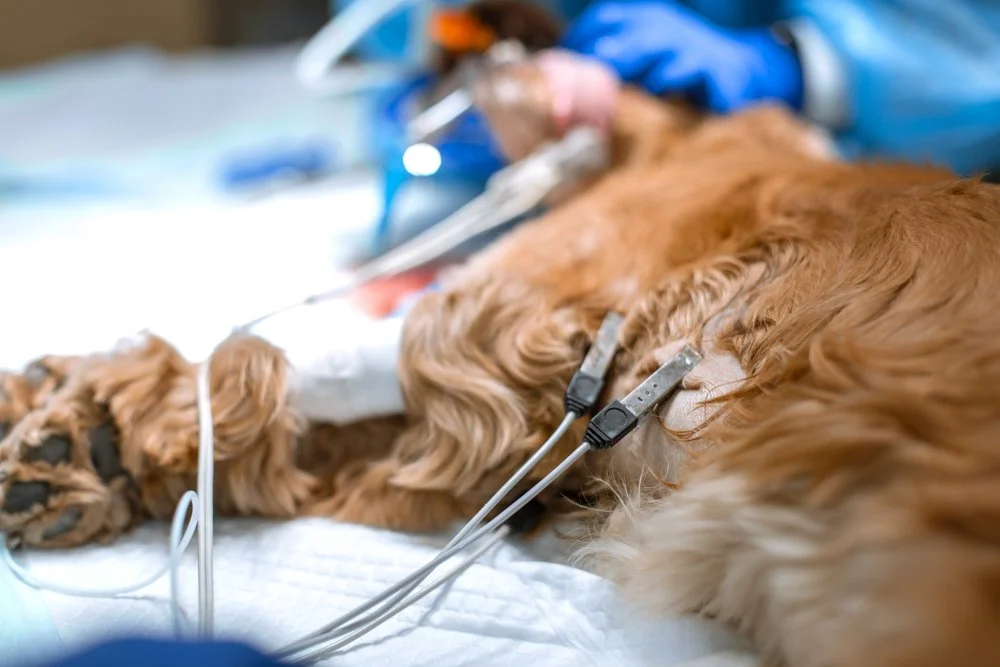
Parameters such as heart rate and rhythm, blood pressure, oxygenation, breathing, carbon dioxide and temperature help the veterinary team recognise changes and respond to them.
Older or medically complicated patients may need a different plan from the healthy six-month-old kitten being desexed.
That's the point of individualised anaesthesia.
But anaesthesia still has risks, doesn't it?
We don't think it's helpful to tell pet families that modern anaesthesia is simply “safe”. Large veterinary studies have demonstrated that anaesthesia-related death is uncommon, but risk varies substantially with the health of the patient and other circumstances. Age can contribute to that risk.
But then there's another part of the decision that deserves just as much attention…
What is the risk of not doing it?
It’s sometimes easy to jump past this question in conversations about anaesthesia.
Imagine a common scenario: your older pet has significant dental disease.
Avoiding the anaesthetic certainly avoids any anaesthetic risk. But it also means leaving them with a painful mouth and progressive dental disease, not to mention serious systemic health risks.
Or perhaps your cat has a mass that needs to be removed and examined.
Not proceeding avoids an anaesthetic today, but it doesn't make the mass disappear.
Doing nothing isn't always the risk-free option.
For any elective procedure, we ask whether what we're proposing is likely to improve your pet's health, comfort or quality of life enough to justify the risks involved. When we recommend sedation or anaesthesia, it's because we believe the expected benefit to your pet outweighs the risks involved.
Senior-care guidelines make essentially the same point: the expected benefit to quality or quantity of life should be considered before surgery, and procedures including dentistry can produce substantial improvements in quality of life in appropriately selected senior patients.
What about dentistry?
Dentistry is probably where we have this conversation most often.
Dental disease becomes increasingly common as pets age, so unfortunately the time when owners become most worried about anaesthesia can also be the time their pet has a greater need for dental treatment.
And as we discussed in our recent Journal article, proper pet dentistry demands general anaesthesia.
Occasionally we may decide the risk really is too high or that a procedure should be modified, staged, delayed or performed in a more specialised setting.
But “they're too old” is never a diagnosis.
My pet has kidney or heart disease. Does that rule it out?
Not necessarily.
But now the conversation becomes much more individual.
Underlying disease may increase risk, require further investigation or change the way we perform anaesthesia. For some patients, stabilising a medical problem first may make sense. Others may benefit from additional monitoring or a modified anaesthetic plan. For more challenging cases, we also regularly consult with specialist veterinary anaesthetists, who can provide advice or attend Evervet to assist with anaesthesia when appropriate.
That's exactly why these decisions belong with the veterinarian who knows the patient rather than with an age cut-off.
So, is my pet too old?
If there's a procedure that could meaningfully improve your dog or cat's health or comfort, don't dismiss it simply because of age.
Ask us about the anaesthetic. Tell us what worries you.
Sometimes we'll recommend going ahead.
Sometimes we'll recommend investigating further first.
And sometimes we will decide together that the likely benefit isn't enough to justify the risk.
That's individualised veterinary care.
Book an appointment if you’d like one of our vets to assess your senior pet’s anaesthetic risk and help with a plan.
Your pet. Your family. Always.